Further reading
On Coptipedia, the Coptic encyclopedia (in French)
Certificate of authenticity
Delivered with your artwork
Your hand-painted icon comes with a certificate of authenticity signed by Armia Elkatcha. It identifies your artwork, its dimensions, its number and its completion date.
- Artist
- Armia Elkatcha
- Artwork
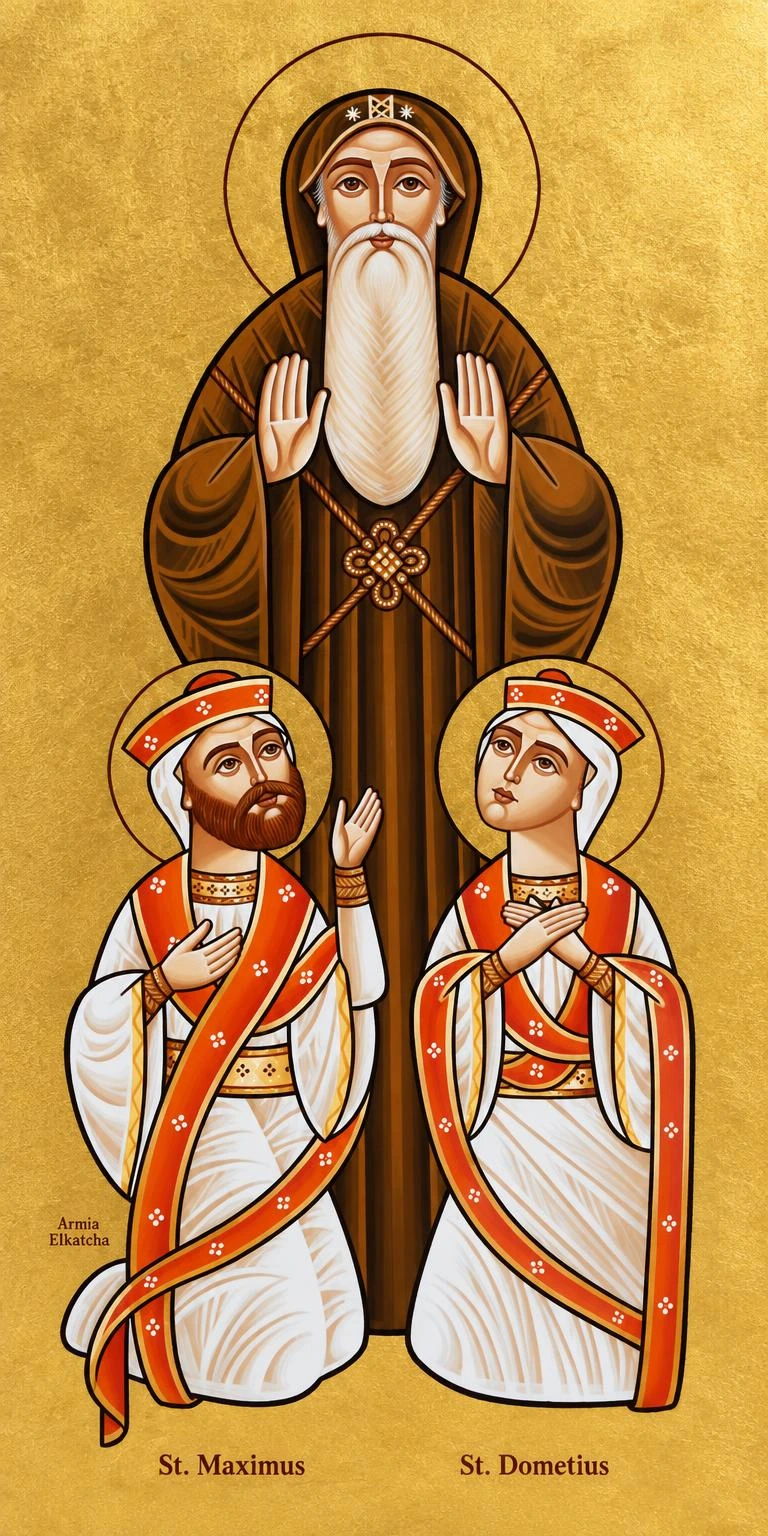
- Saint Macarius the Great with Saints Maximus and Domitius
- Dimensions
- 90 × 130 cm
- Certificate number
- Assigned to your completed artwork
- Completion date
- Recorded upon completion
Armia Elkatcha’s signature
Signed by the artist on the certificate delivered with the artwork
Apostles, martyrs and saints
Saint Macarius the Great with Saints Maximus and Domitius
Unique and personalized icon by Armia Elkatcha. Size to choose. Be careful, the smaller the icon, the less detail the artist can insert into it. The photo corresponds to size XL.
Prices include French VAT at 5.5%
Hand-painted on request · Delivered in 2 to 4 months · Free delivery
'Everyone who has left houses, brothers, sisters, father, mother, children or land for the sake of my name will receive a hundred times as much, and also inherit eternal life.'
Gospel according to Saint Matthew 19:29
Saint Macarius the Great (c. 300-390), also called Macarius the Egyptian, is the father of the monks of the desert of Scetis (Wadi Natrun), where the monastery bearing his name still stands today. A disciple of Saint Anthony, he was a master of prayer for generations of monks. According to Coptic tradition, two young brothers, Maximus and Domitius, sons of Emperor Valentinian, left the palaces of Constantinople to become his disciples. They lived in great humility and died young, one after the other. Saint Macarius had a church built on the site of their cell, saying: 'Call this place the cell of the young Romans.' This is the origin of the Monastery of the Romans, 'El-Baramous', still inhabited today. The Coptic Church celebrates Saint Maximus on 14 Tobi (22 January) and Saint Domitius on 17 Tobi (25 January).
References: Matthew 19:21 and 29; Luke 14:33; Psalm 133 (132):1.
Studio journal
From preparing the support to the final details: the usual stages of a hand-painted icon.
Prepare the wood
The wooden support is prepared to receive the drawing, gold leaf and paint.
Draw the composition
The scene, figures and symbols are arranged according to the chosen representation and size.
Apply the gold leaf
Gilding brings light to the background and halos, in the tradition of the Coptic icon.
Paint the icon
Colours, garments and faces are painted by hand. The level of detail is adapted to the size of the artwork.
Finish and authenticate
The final details and finishing touches are completed. The artist signs the certificate bearing the artwork’s number and date.